verostko main menu | contact | copyright | home
THE ALGORISTS by Roman Verostko
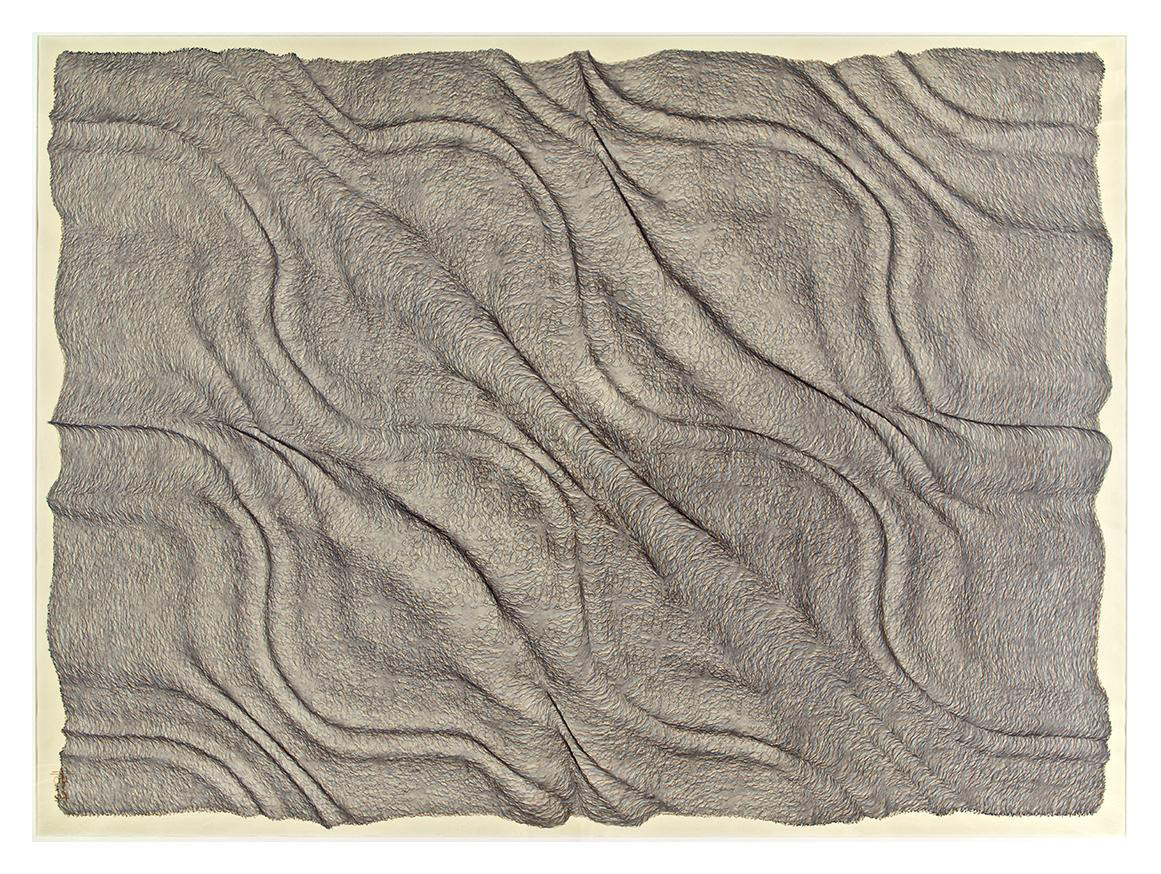 |
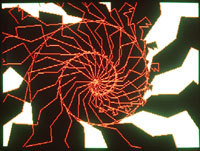
Jean-Pierre Hébert
Chicago, 1992, © j.p.hebert |
Often I am asked "Who are the algorists?" Simply put an algorist is anyone who works with algorithms. Historically we have viewed algorists as mathematicians. But it also applies to artists who create art using algorithmic procedures that include their own algorithms. This page presents an account of the adaptation of this term by a group of artists in 1995. Algorithmic art has a deep history that reaches back to prehistoric art. But the advent of computing power spawned an artistic practice with form-generating features that is relatively unique to the last quarter of the 20th Century. Computer power gives the artist's algorithms a leverage we might liken to the power of the engine in the industrial revolution. In 1969, when I first tasted algorithmic leverage, I set out to learn how to use it as an artist.
|
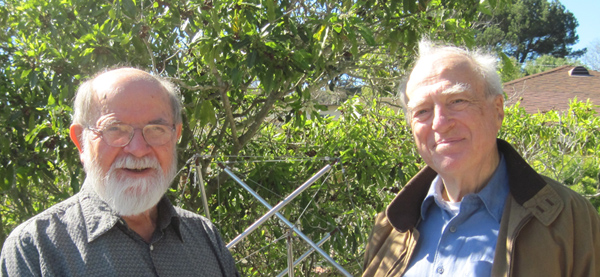
Roman Verostko (left) and Jean Pierre
Hebert (right), 2011, Santa Barbara. In 1995, Jean-Pierre suggested that we adapt the |
Revisit my 2003 |
I met other artists following the same path who were interested in an identity for their algorithmic art practice. It was Jean Pierre Hebert (JPH) who suggested we adopt the term "algorist" and he also wrote the algorithm for an algorist. This algorithm is now viewed as the "algorist manifesto" and it was JPH who led discussions and correspondence in establishing its usage. While the practice of algorithmic art reaches back to pre-historic basket-weaving and tool-making the implementation with computing power provided new "form-generating" capabilities.
Although adapted in 1995 the term applies to work by colleagues that date back to the 1960's and even earlier. With the rise of ubiquitous computing algorithmic art now ranges from games and interfaces with biological life to experiments with the evolution of form and social consciousness.
The term "algorithm"
The term algorithm is an alternative spelling for the term "algorism". Thus a person who works with algorisms (or algorithms) is an algorist. Traditionally the term algorist is associated with mathematicians. An algorithm refers primarily to the step by step mathematical procedure for carrying out a specific calculating task (see note 1). With the advent of computers we find ourselves writing procedures that reach beyond solving mathematical problems. The detailed instruction directing a drawing machine on how to draw a visual form is also an algorithm. Today, more broadly, a composer's score for musical form and a choreographer's notations for dance may also be viewed as algorithms. Such notations, similar to computer software formats, are detailed procedures for carrying out a task. From this perspective we could also view the recipe for baking a cake as an algorithm.
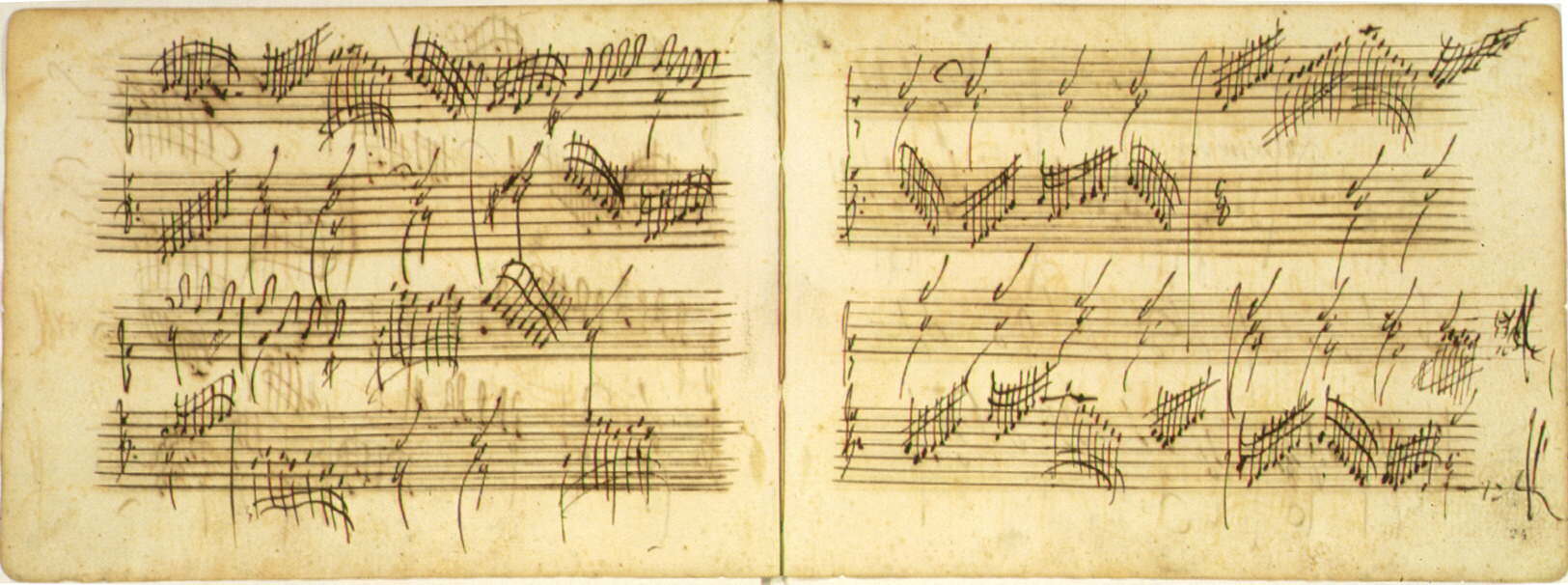 |
This Seventeenth Century keyboard music, is thought to be in the hand of the great keyboard composer, Girolamo Frescobaldi (1583-1643). The Vatican folios shown (23 & 24) display the opening from his Fourth Toccata. The score may be viewed as an algorithm, expressive both in structure and in the writing hand of the composer. © Vatican Library MS: Chig. Q. IV 29 fols. 23 verso-24 recto music17 NB.40. Image source: http://www.ibiblio.org/expo/vatican.exhibit |
Algorithmic art may be found throughout history, from prehistoric basket weaving to geometric and conceptual art in the 20th Century. However, the advent of computers provide us with form-generating leverage that, to the best of my knowledge, has no precedent in the history of art. It is in this sense that algorist artists of the late 20th Century pioneered procedures that have come to permeate the visual and sound arts in the 21st Century.
|
|
 |
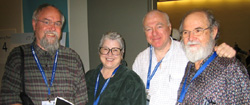
| Left to Right: Mark Wilson, Manfred Mohr, Roman Verostko & Frieder Nake: Four algorist pioneers at the Victoria & Albert, Museum, Jan 5, 2010. Photo by Douglas Dodds in the context of a V & A display of their work. |
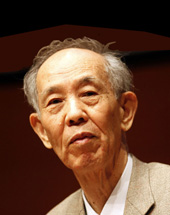
Hiroshi Kawano 1925-2012 photo at ZKM in 2010, ©zkm |
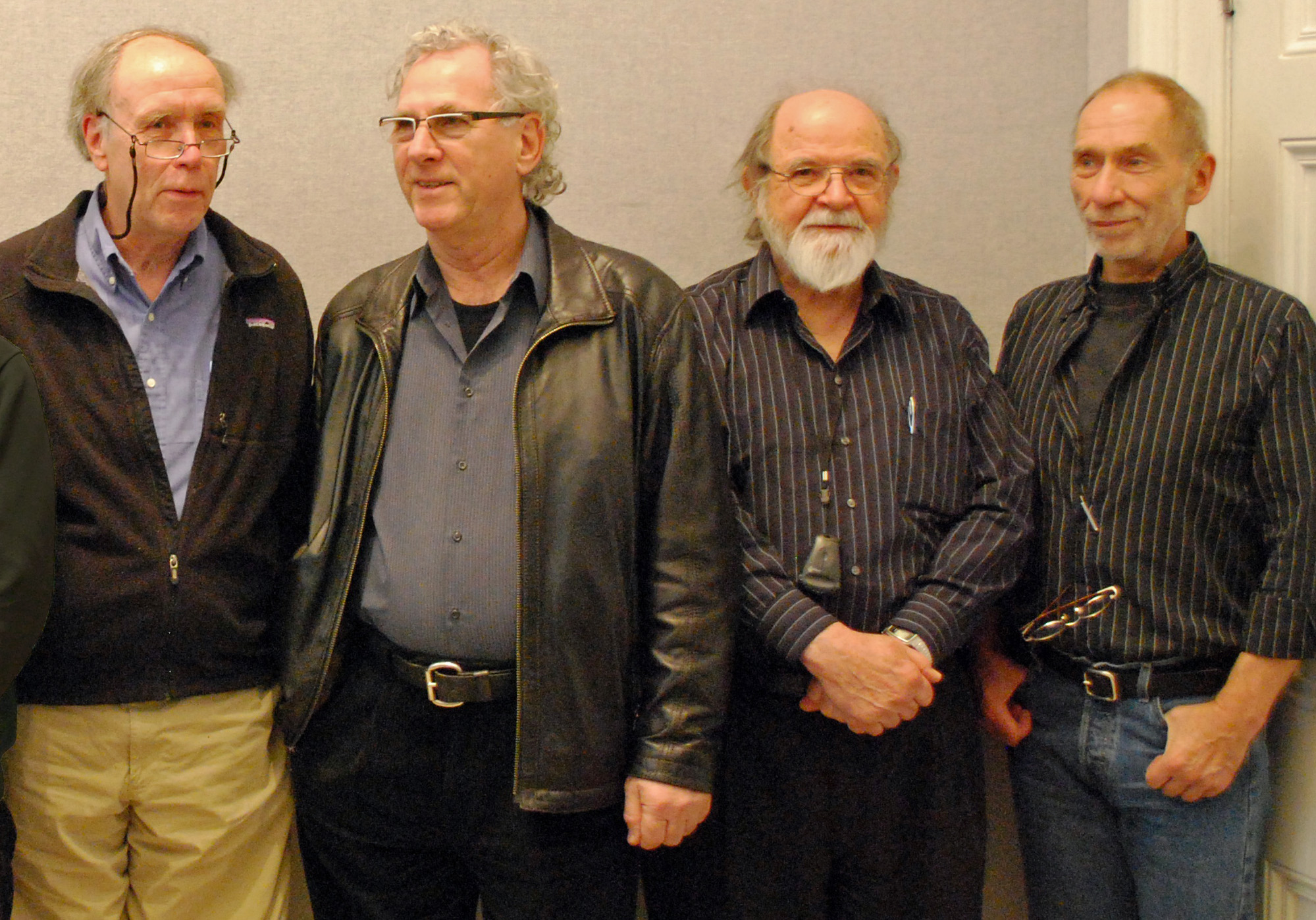
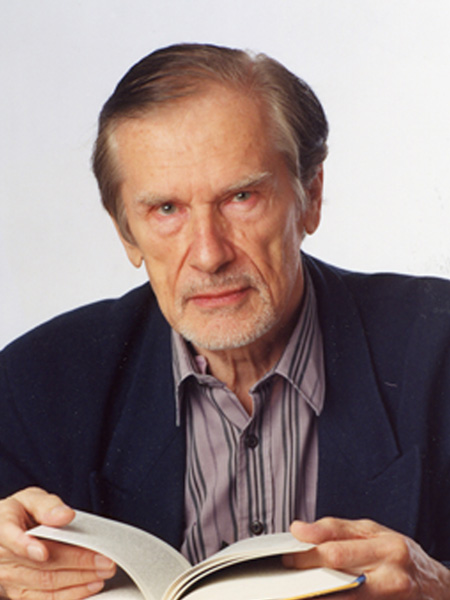
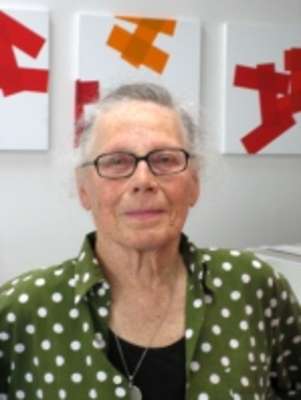
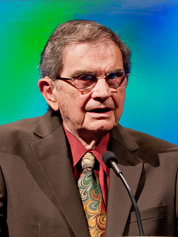
In the latter half of the 20th Century, with the growth in information science and digital technologies the use of algorithmic procedure spread far beyond the dreams of its earliest practitioners. We have, among the living in 2012, a number of algorists whose vision and work with programming pointed the way that permeates the world of art today. Pictured above, in a single frame, are four algorists who were present in the context of a display of digital pioneer works at the Victoria & Albert in London, 2010. A retrospective of the pioneer work of Hiroshi Kawano, pictured above, was presented at the ZKM in Karlsruhe, Germany, in 2011-12 before he died. While not present for the photo above, celebrated pioneers like Herbert Franke, Vera Molnar, Charles Csuri, and Harold Cohen (shown below), were also represented in the Digital Pioneers V&A display (Note 8.) . Other important contributors to the pioneers showing, not pictured here, included George Nees and Edward Zajec.
 |
 |
|
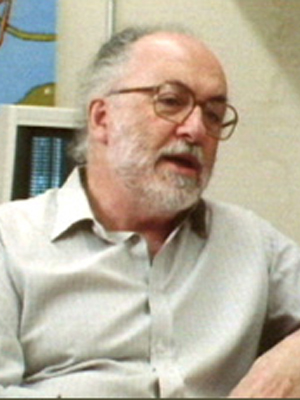 |
| Herbert Franke, photo by Andreas Hübner | Vera Molnar, 1985, archives of Frieder Nake's comp-art data base. | Charles Csuri on occasion of his SIGGRAPH Lifetime Achievement Award, 2011,.Vancouver, Canada. | Harold Cohe (1 May 1928-27 April 2016 ) From the film: Age of the Intelligent Machines |
Historic Notes: Writing the score for drawing.
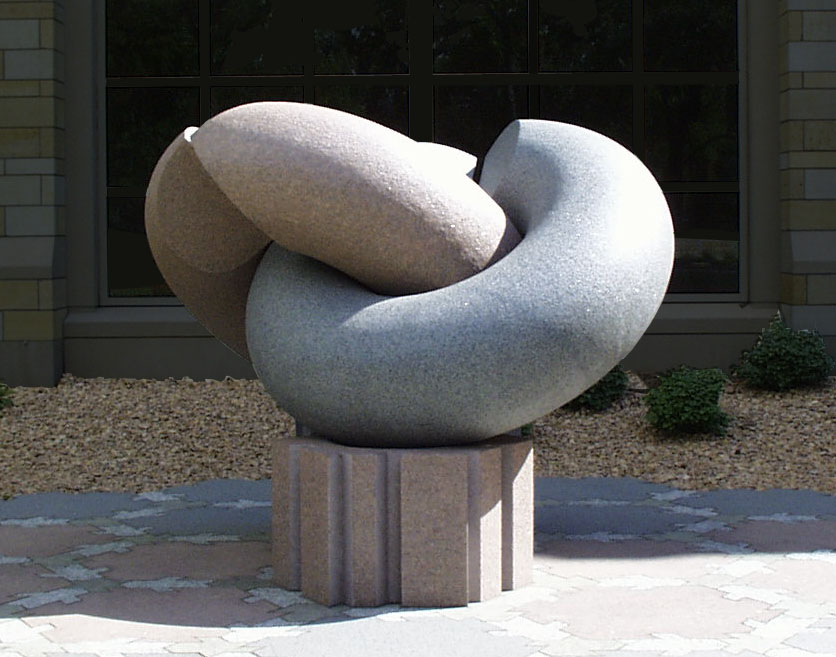
In the last quarter of the 20th Century I was one of a like minded group of artists who undertook to write instructions for executing our art. In the 1970's & 80's "Computer art" was the term generally applied to all art associated with computers. Some of us had been working with algorithmic procedure for about a quarter century before our 1995 declaration as "algorists". The 1995 manifesto of the "algorists" was not a declaration of something new; rather, it was giving identity to an artistic practice that had already brought radical change and would continue to change the way we would create art in the 21st Century. The algorist adaptation provided a name for artists who practiced algorithmic art. This practice also had a valuable presence in sculpture and music. Helaman Ferguson would be a sculptor whose algorithmic art celebrated an aesthetic rooted in mathematics. His "Four Canoes", shown below, is an excellent example with links to information on the procedure for achieving the form of the tori, the pedestal, and the platform.
|
|
Helaman Ferguson "Four Canoes", 1997, University of St Thomas Science and Engineering Center, St. Paul, MN, USA. This impressive algorithmic presence features two interlocked six foot granite tori mounted on a platform created with hexagonal tiling. See also: UmbilicTorus at Stonybrook |
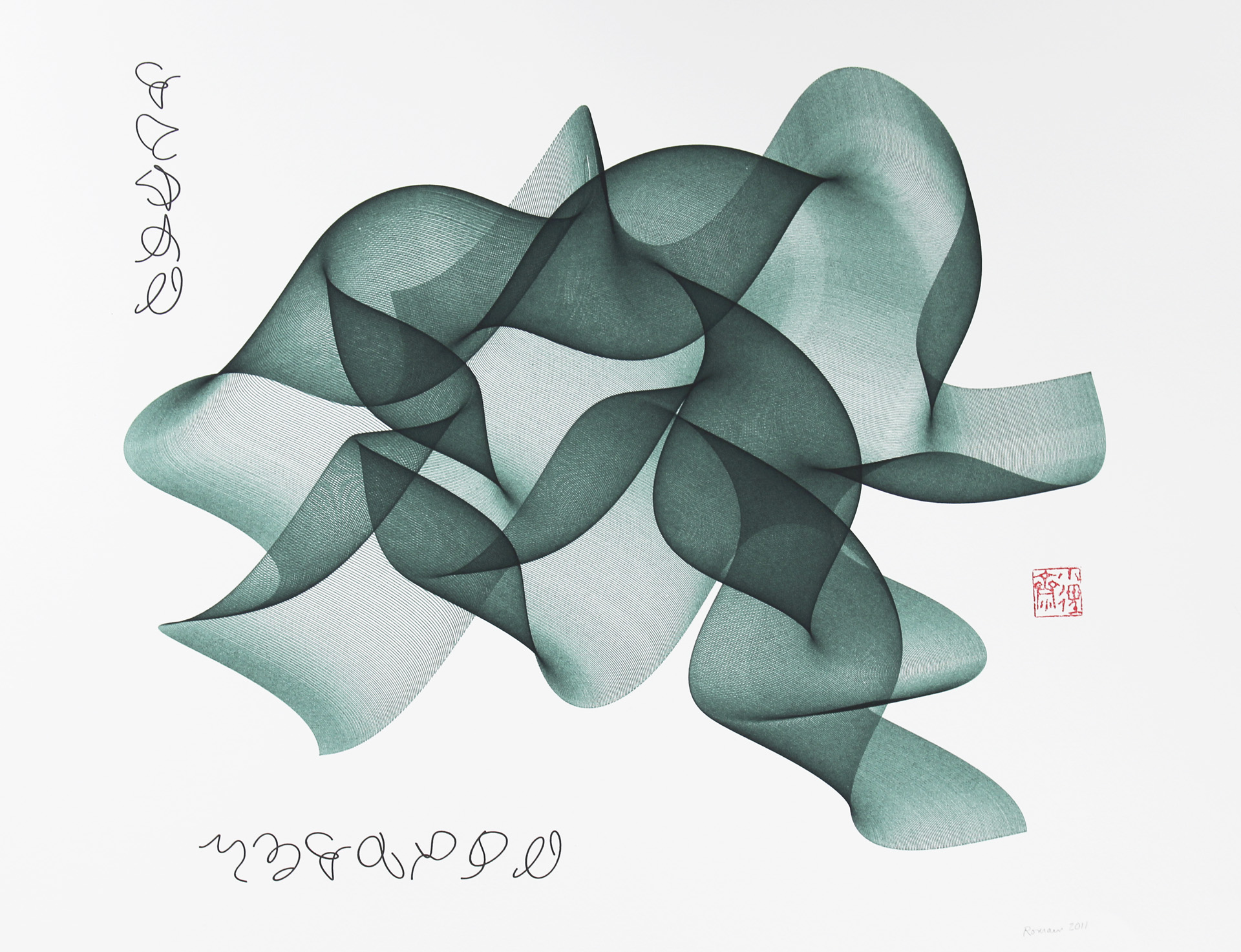
Yet algorithmic art should not be confused with the practice of mathematics. The process of writing the score for a drawing requires poetic engagement similar to that required for composing the score for music. Algorithmic drawings, like my "Green Cloud" shown below, evolved from my passion, as a painter, for the marriage of spontaneous brushwork and studied arrangement. With elementary programming abilities I explored the same goals I had set for myself as a painter. Clearly programming and mathematics do not create art. Programming is a tool that serves the vision and passion of the artist who creates the procedure.
 |
|
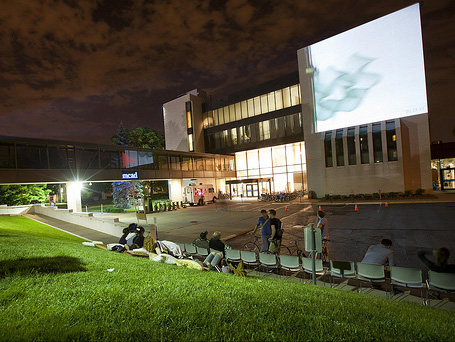
| *Green Cloud (the drawing)" by Roman Verostko. Pen & ink plotter drawing. Drawing process presented as a Three Story Drawing Machine, June 2011 at the Minneapolis College of Art & Design (MCAD). | Three Story Drawing Machine, north wall, MCAD, Northern Spark, "White Night", ca. 4:30 AM, June 5, 2011, nearing the end of an 8 hour, all night drawing session. |
LOOKING BACK
Before looking back let me note
that several pioneer algorists have carried their form explorations well
into the 21st Century. Of these Manfred Mohr and Harold
Cohen
stand out as two of those master pioneers who were the first to achieve
mature algorithmic styles. Manfred's "Klangfarben"
series demonstrates the power of
algorithmic procedure in the hands of a master.
Manfred has labored for over 40 years creating visual tension fields as an
art of pure visual form. In this series we experience algorithmic form
generation in real time.
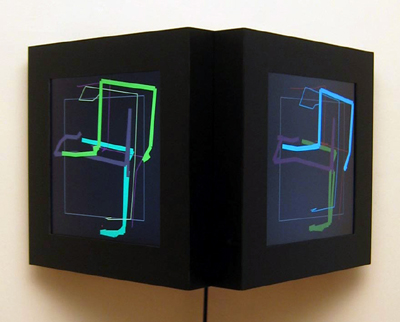 |
 |
|
|
Manfred Mohr,
"Klangfarben" series (2006-2007)
from Bitforms Gallery on Vimeo. © Manfred Mohr |
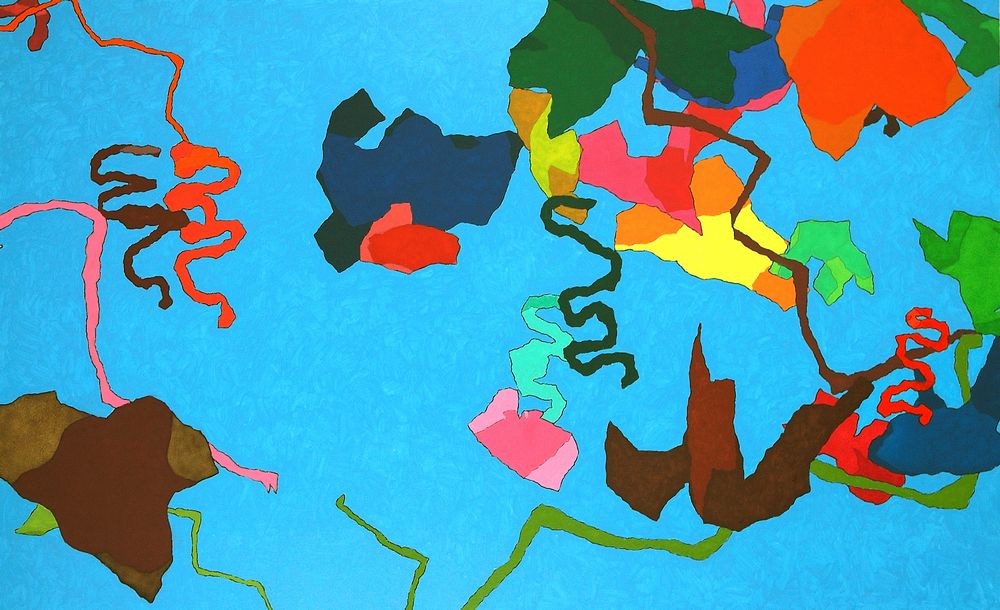
Harold Cohen, Starting Over, 2011, oil painting, 50 by 80 inches |
"Aaron", a personification of Harold Cohen's software, represents over 30 years of work on creating an intelligent artist. Aaron's drawings and paintings, grew from Harold's earlier experience as a painter. Consequently "Aaron's" code appears to yield a mysterious relationship to Harold as the artist-painter in his earlier years.
Historically how did we get here?
In the earlier days of computing there were
no software tools for artists. Frieder Nake told me how he came upon the
task of writing software for a drawing machine at the University of
Stuttgart in 1963. The company did not supply software with the
machine and he was assigned the task. During the 1960's
several artists like
Manfred Mohr and Hiroshi Kawano saw the "form-generating" power of computers
as an opportunity for art. Hiroshi Kawano had hoped to gain insight
into the logic underlying our creative process. Software and technical procedures for visualization
grew hand in hand with hardware. Artists engaging new computing and
visualizing technologies had to either collaborate with engineers for
programming their ideas or else create their own programs (algorithms).
|
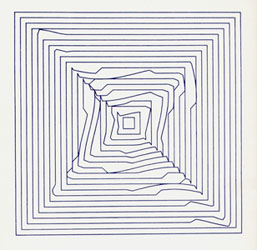
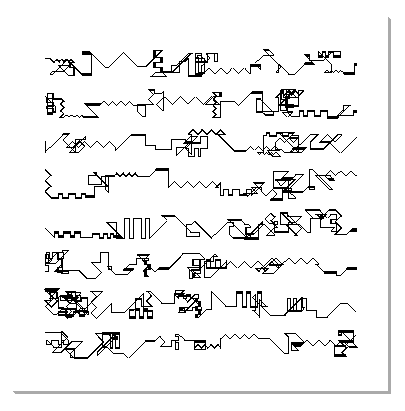
Manfred Mohr, New York P-021/A, "band-structure", ink/paper, 1969, 50cm x 50cm Early plotter drawing in a series achieved with algorithmic procedures that included rules he viewed as "aesthetical-filters"
http://www.emohr.com/ |
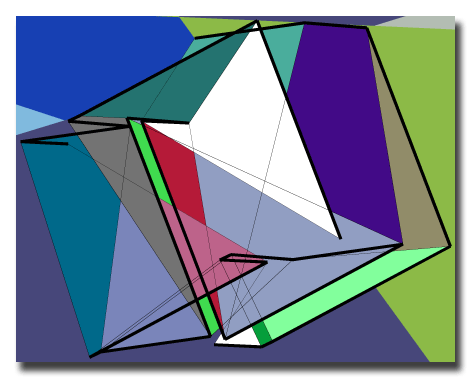
Those artists who first experimented with coded artistic procedures with computers included Hiroshi Kawano, Herbert Frank, Manfred Mohr, Frieder Nake, Georg Nees, Vera Molnar, and Edward Zajec. Artists who used computers in the art-making process were often called "computer artists". Frieder Nake, a pioneer algorist, has, in recent years, served as the chief investigator documenting first generation "Digital Art" at the University of Bremen in Germany. This "CompArt" data bank provides an excellent source for perusing the breadth and depth of early algorithmic art. From the 1970's up to the early 1990's this work was generally referred to as "computer art", a term that became the umbrella for any kind of art associated with computers.
|
|
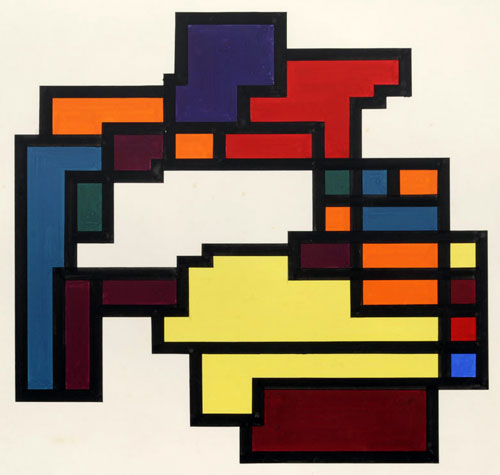
Artificial Mondrian, 1967. Rendered in Gouache on paper. The model for this work was coded in Fortran with a HITACHI 5020 in Tokyo. ZKM Collection, Karlsruhe. Hiroshi Kawano (1925-2012) began exploring visual form with computers in order "to understand the logic of the creative process in human art"In Memory of Hiroshi Kawano by Margit Rosen
|
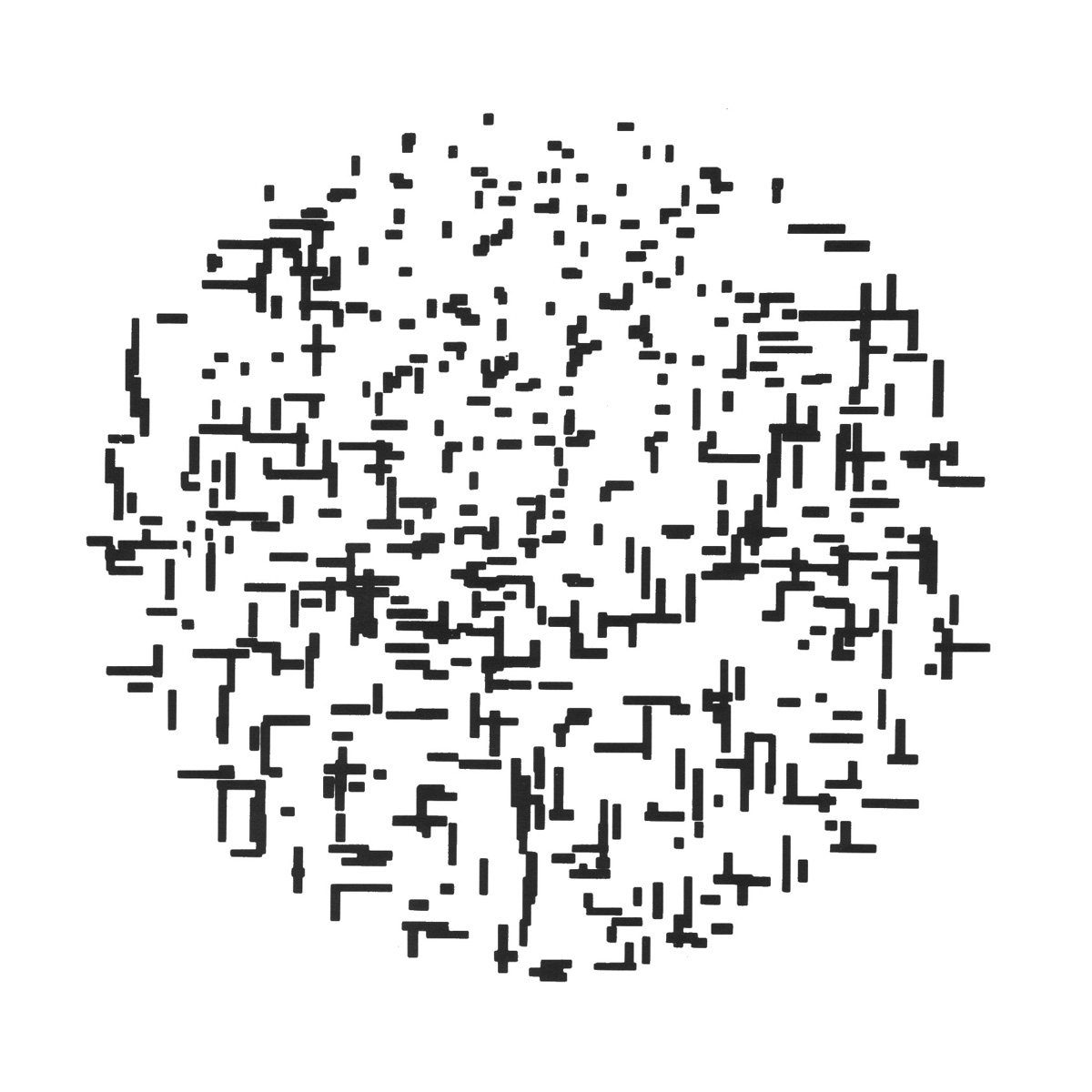 |
A.Michael Noll, USA, Computer composition with lines, 1964. This drawing was meant to mime procedures similar to those employed by Mondrian for his "Composition with lines". For sources see Note 7 Hardware: IBM 7094 computer and a General Dynamics SC-4020 microfilm plotter. |
|
|
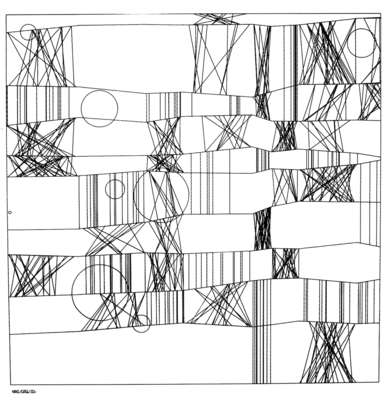
Frieder Nake, Germany
Nr. 2 Homage à Paul Klee, |
 |
 |
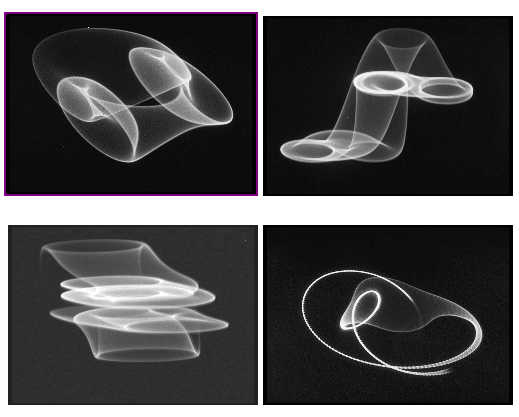
| Herbert Franke, Electronic Graphics,1961-62.. |
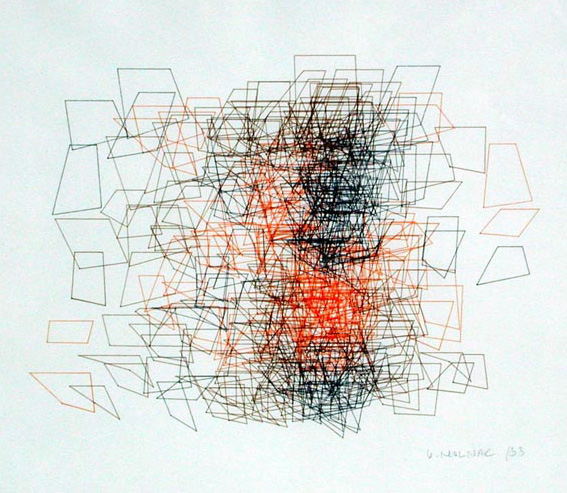
Vera Molnar,
Quadrilaterals, pen & ink, 1988 30 by 35 cm., Coll. Szollosi-Nagy-Nemes |
|
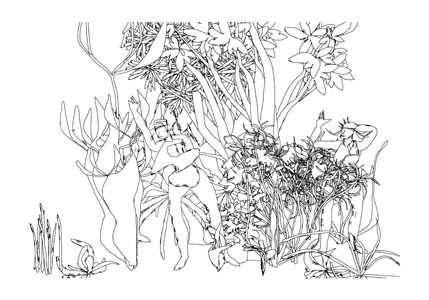
Harold Cohen,
1999 Aaron's Garden, pen and ink drawing plotted by Aaron in 1989. "Aaron" is a "personal expert system" that Harold Cohen developed for generating art. "Aaron" consists of Harold's coded program of generative drawing procedures and a flat bed pen plotter. Aaron's drawings of two figures in a garden recall the tradition of representing Adam and Eve in the Garden of Eden. © h.cohen |
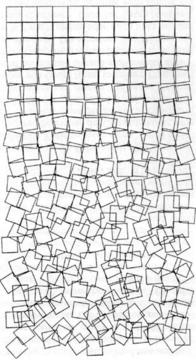 |
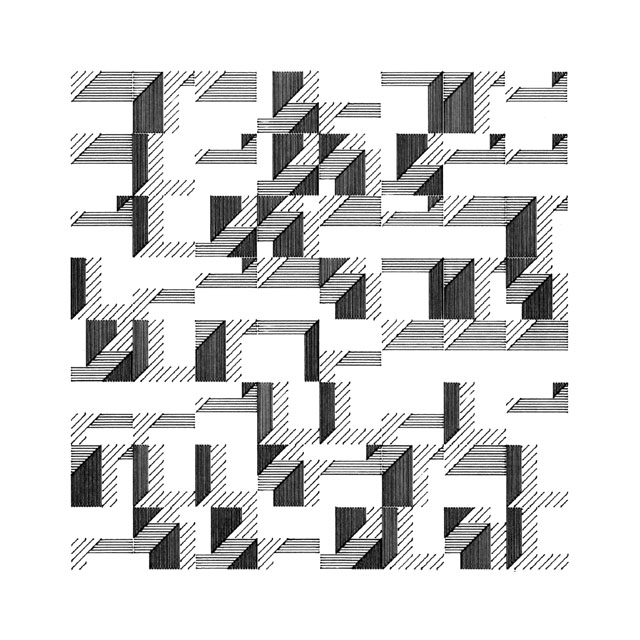
Above: Edward Zajec left: Georg Nees,
«Schotter». " a computer graphic from the 1960s, |
Venues for exhibiting "computer art" emerged in the 1980's when various symposia and conferences, both national and international, began including exhibitions and papers related to the use of computing procedures in the arts. Leonardo, the quarterly on art science and technology, played an important role for emerging algorithmic art by including essays and documentation of exhibitions for ISEA, the Digital Salon, and SIGGRAPH . Ars Electronica, with its annual symposium, catalogues and awards provided us with papers and examples with a growing community of practitioners. (See note 2)
By the mid to later 1980's a fair number of artists using
original algorithms had achieved distinctive algorithmic styles, each
with a body of mature work. Working independently of each other, we found,
when we did meet, that we shared many similar experiences.
Furthermore we could be helpful to each other by establishing our unique
identity. While I had little contact with Manfred Mohr, Frieder Nake, and Vera Molnar I was aware of their work and shared some of
the same exhibiting venues.
ALGORITHMIC SEDUCTION
 |
| Detail: Flowers of Learning, Madame Curie. Algorithmic pen ink drawing, one of seven in a 25 foot permanent installation, Spalding University, Academic Learning Center, Louisville, Kentucky, USA, Roman Verostko, 2006. PDF Catalogue: Flowers... |
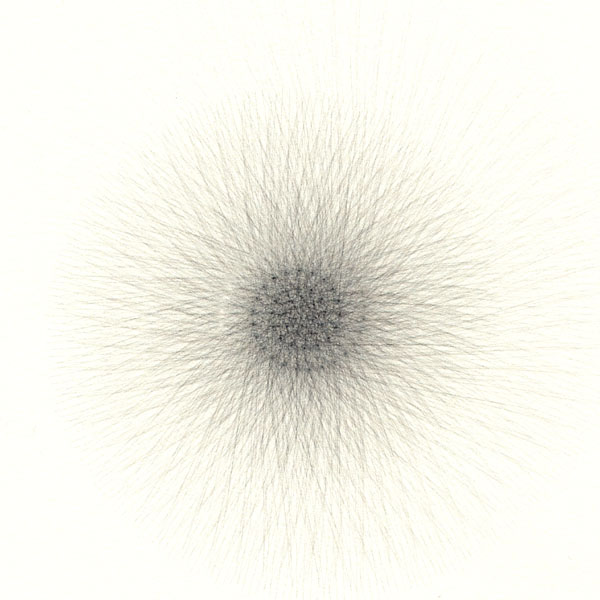
| Jean Pierre Hebert, 1999 Santa Barbara, CA Artist's coded procedure from 100 views of a megagon. print 8" by 8" image on paper,
Somerset Book, measuring 12.75" by 19". |
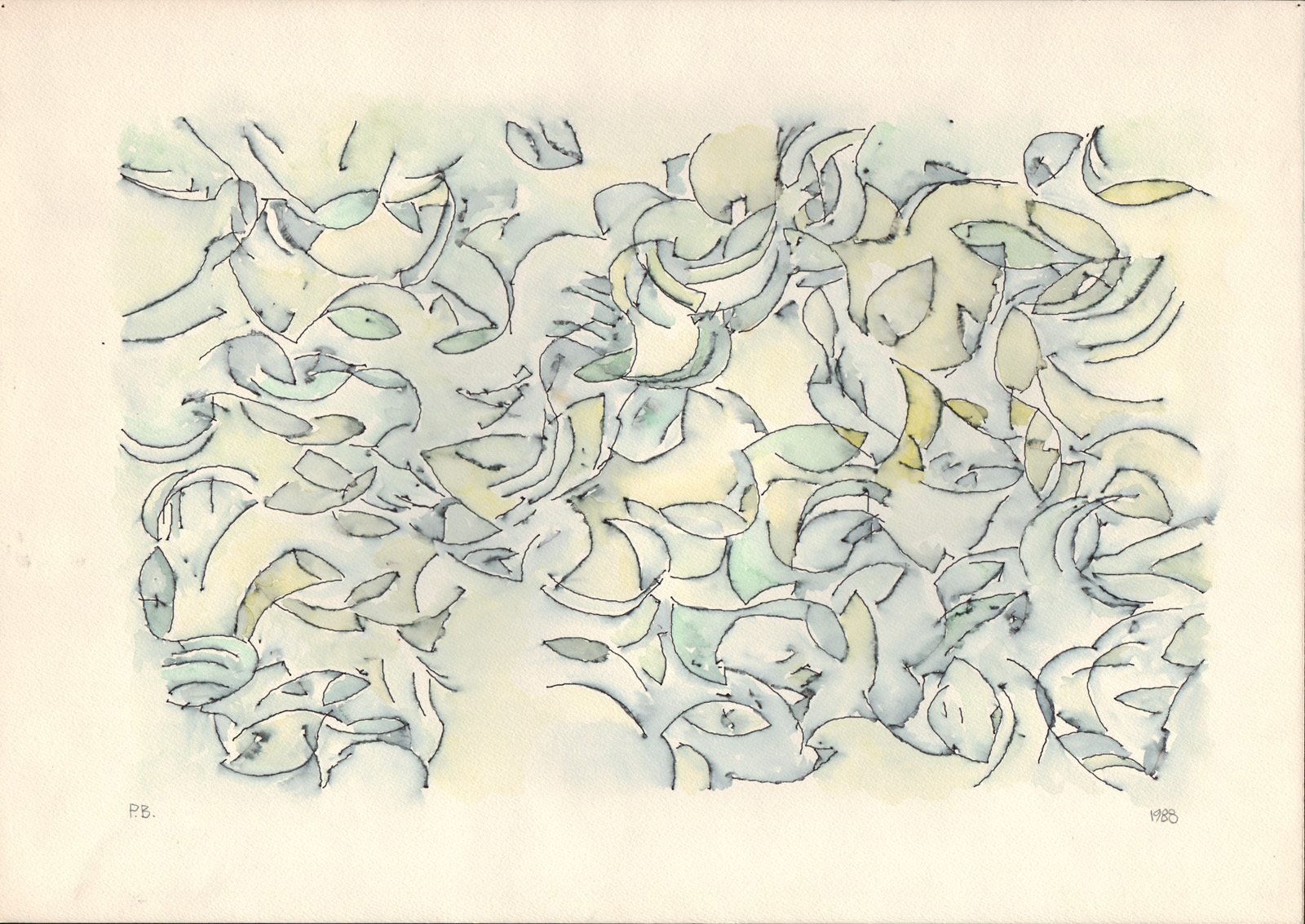 |
Peter Beyls, 1988 Ghent, Belgium Untitled algorithmic pen plotter drawing tinted with watercolor. 11.5" by 16.5" Artist's software Hardware: Symbolics 3600 & HP plotter © p.beyls |
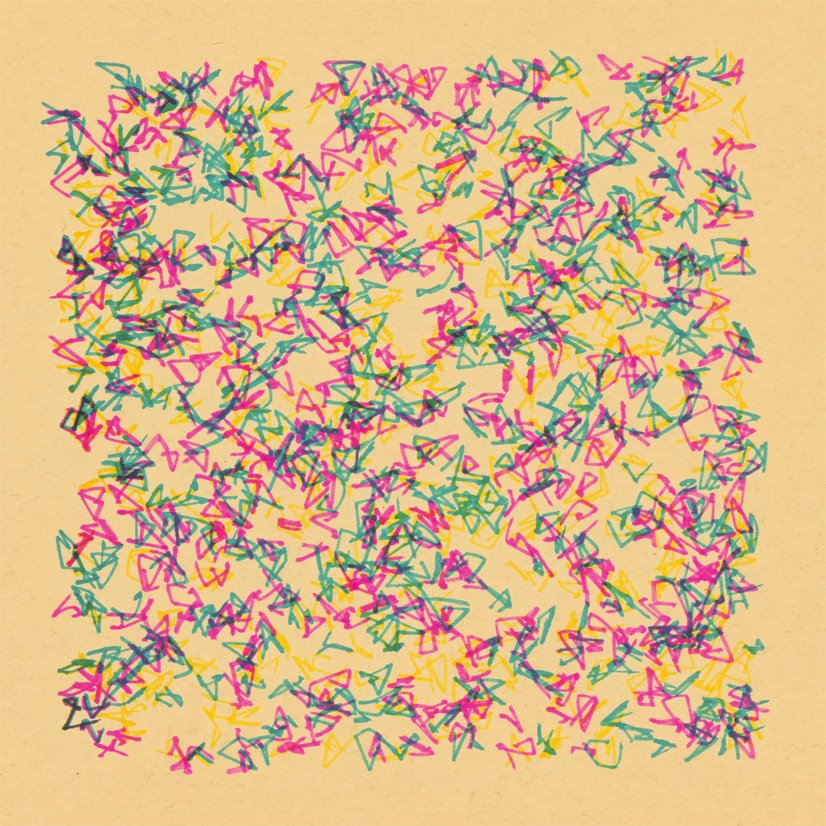 |
Stephen Bell, 1977-79. Detail of
one of a drawing created with his ranstack algorithm. The ranstak programs were the first programs developed by Bell as a postgraduate student at the Slade School of Art in 1977-79 in the Department of Experimental & Electronic Art. |
I met Peter Beyls, Stephen Bell and Brian Evans at the first ISEA in Utrecht in 1988 where we presented papers on our algorithmic practice. As I recall, we were all interested in identifying what was unique in the work of artists who pursued algorithmic art. At the Minneapolis ISEA in 1993 Peter Beyls and I discussed forming a panel on algorithmic art for the 1994 Helsinki ISEA. Peter chaired the Helsinki panel and planned a similar panel on "Artists and Algorithms" for the 1995 SIGGRAPH conference in Los Angeles, USA. We invited Jean Pierre to join us in the 1995 panel. This panel, chaired by Peter Beyls (Belgium), included Jean Pierre Hebert (US), Brian Evans (US), Stephen Bell (UK), Ken Musgrave (US) and myself. My paper identified specific features and procedures that lay at the core of algorithmic art (see: http://www.verostko.com/alg-isea94.html )
In an informal casual meeting sometime shortly after the panel, Jean Pierre, Ken Musgrave and I briefly discussed forming an informal group of artists who shared similar interests in algorithmic art. We were especially interested in establishing a name for those of us who practiced algorithmic art. I have always felt that the title of our panel, the milieu of that conference, the vitality of the panel members and our shared common interests, was the springboard for establishing our identity as "algorists".
 |
|
|
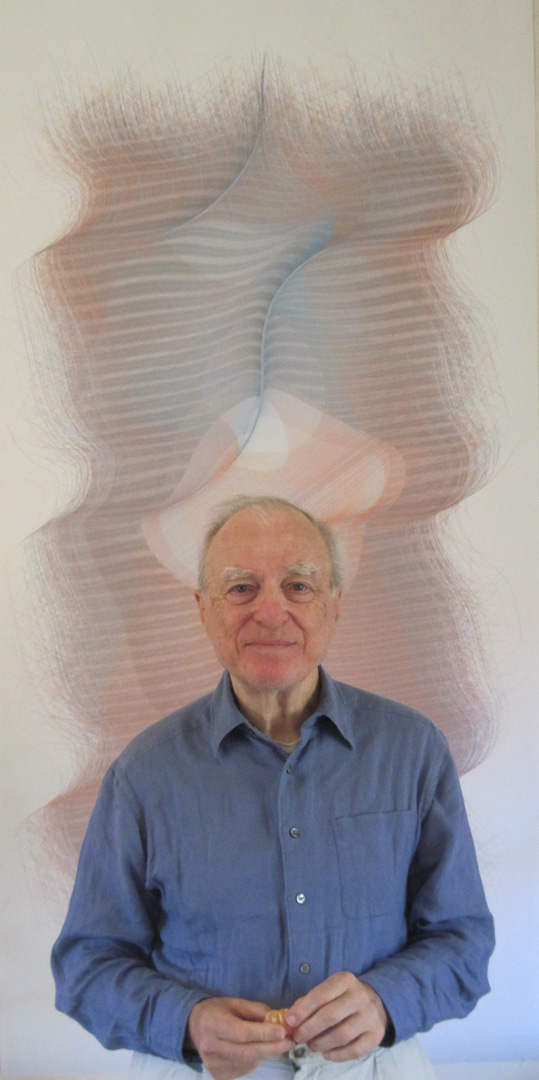
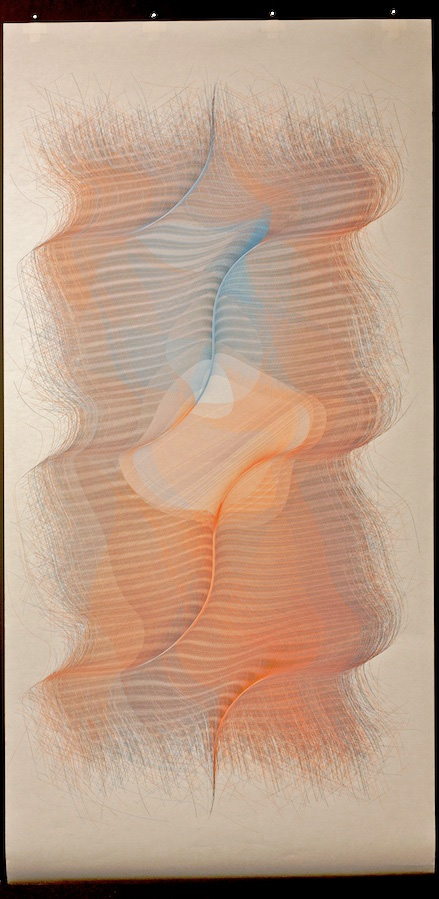
Above: Jean-Pierre Hébert with two of his
"Bright Wavelet" digital drawings, 2008 (38" by 77").
Hebert played a key role in establishing usage of the term algorists (note 9), www.jeanpierrehebert.com , photo by roman, 2011 |
|
Following the conference Jean Pierre Hebert, Ken Musgrave and I began correspondence in search of a term and possible ways to share views. During that period we invited others to join in this exchange. We added a number of artists to a list and also had invited several others to join in the correspondence. ( Note 11 ) It was Jean Pierre who proposed using the term "algorist". Noting that algorists "ought to be defined with an algorithm", he also wrote an algorithm identifying an algorist as one who uses one's own algorithms for creating art objects. The correspondence I have located is dated August 31, 1995 (Note 10) Jean Pierre's name for the group and his algorithm were both brilliant contributions serving as an identity and a manifesto. The Hebert algorithm, as quoted below, is formatted precisely as received :
if (creation && object of art && algorithm && one's own algorithm) {
include * an algorist *
} elseif (!creation || !object of art || !algorithm || !one's own algorithm) {
exclude * not an algorist *
}
So artists who create an object of art with a process that includes their own algorithms are identified as algorists.
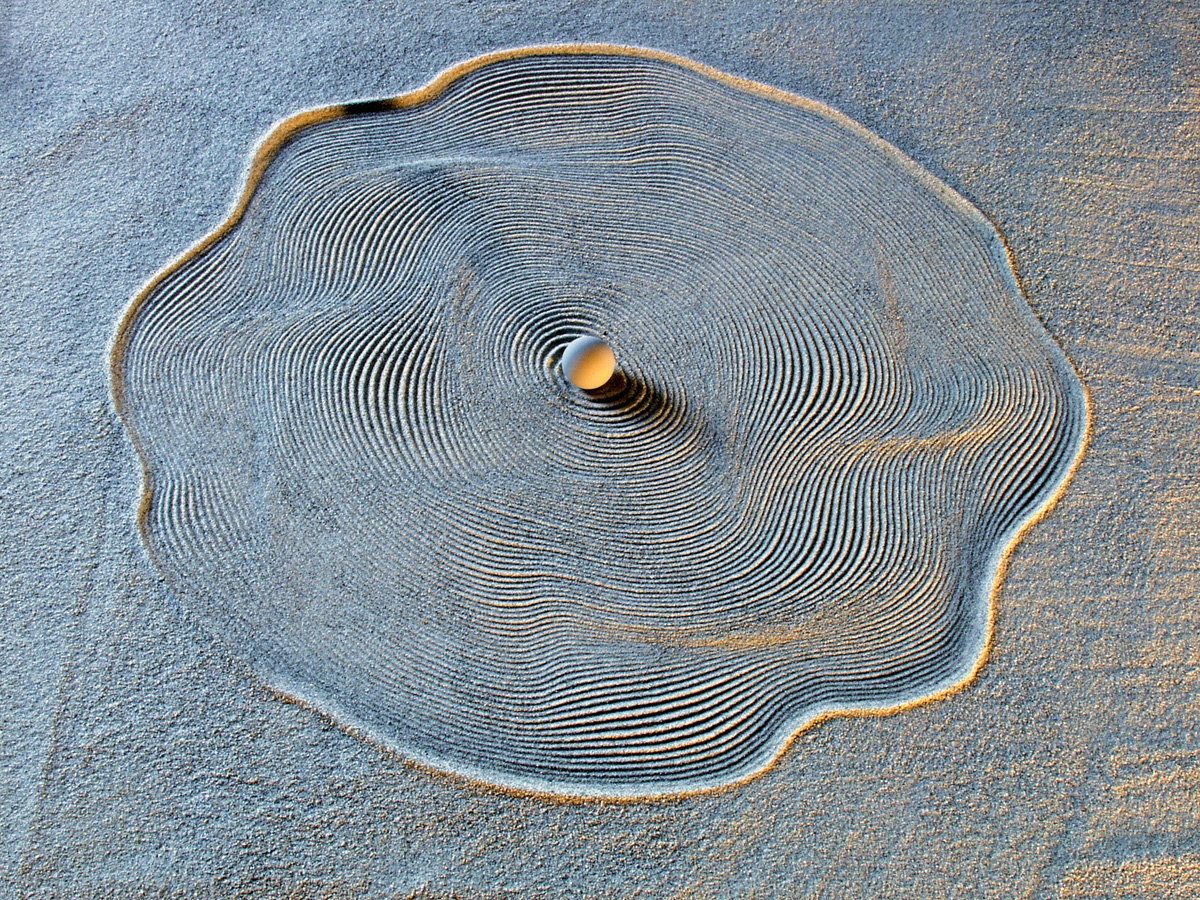 |
Jean-Pierre Hébert sand trace 2003 © jp hebert |
In the late 1990's Jean Pierre and I continued to exchanged ideas and I usually visited with him when SIGGRAPH met in LA. After the turn of the Century I wrote a review of his work that had never been published. This review followed one occasion when my wife and I enjoyed experiencing, along with Claire and Jean Pierre, a late evening watching his Sisyphus slowly tracing pathways in the sand. Recently I located the article along with our earlier 1995 correspondence. I am posting my review here for colleagues who may not be aware of how much we shared in the 1990's. See: Jean-Pierre Master Algorist.
 |
 |
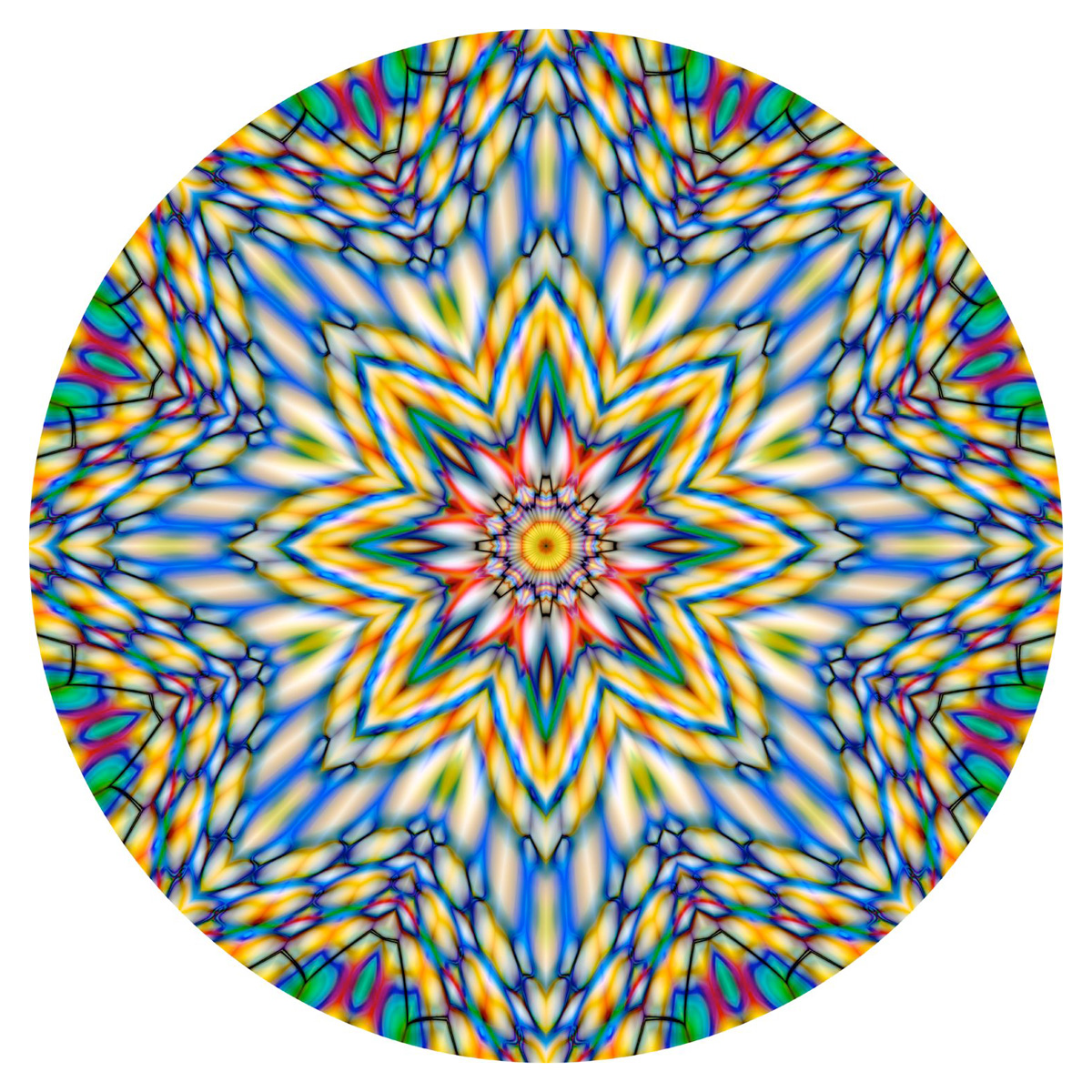
| Above: Brian Evans,
A visualization (a mapping) of Beethoven’s Ode to Joy, date unknown. see note 5 see: www.brianevans.net © Brian Evans |
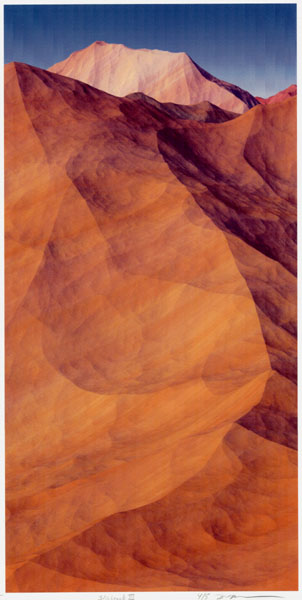
Ken Musgrave, USA, Inkjet on rag
paper . 4" of 5 ', ca. 1995 Slickrock III, 11.5" by 20.5" © k.musgrave |
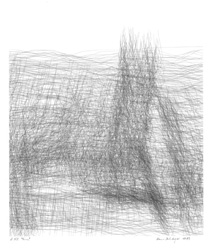 |
Hans Dehlinger, Kassel, Germany
D162 "Turm", 1993 Pen & ink. algorithmic pen plotted drawing. Private Collection © h.dehlinger |
As artists employing algorithmic procedures the term algorist fit our interests well. In general we are fairly agreed that algorists are artists who include original algorithmic procedures in the course of creating their work. The use of algorithms in and of itself does not constitute algorist work. It is the inclusion of one's own algorithms that makes the difference.
As algorists with or without computers, we all employ algorithms created by colleagues and predecessors. The algorithms for geometry and perspective come to mind. We depend on algorithms others have created for everything from the circuit logic and operating system of our computers to the computer languages and the editors that we use.
The algorist goes one step further by introducing original algorithms for generating "art". The jewel of algorist art lies in the artist's own "form-generating algorithms", the artist's unique procedures for creating the form. From this perspective Mozart's score for a Sonata, the architect's plan for the building, and Hans Dehlinger's code for a drawing are all "form-generating" algorithms.
Algorithms have been used variously in the arts for centuries. And the procedures were carried out manually without the use of machines. Clearly an algorist may also practice her art without the use of computers. That has been the case in the work of Channa Horwitz (1932-2013) whose algorist work was executed entirely by hand. Her algorithms are profoundly informed by progressions and number. Channa is one of the four algorists in the first show that Jean Pierre Hebert curated at the Kavli Institute for Theoretical Physics in Santa Barbara, a show noted at the end of this essay.
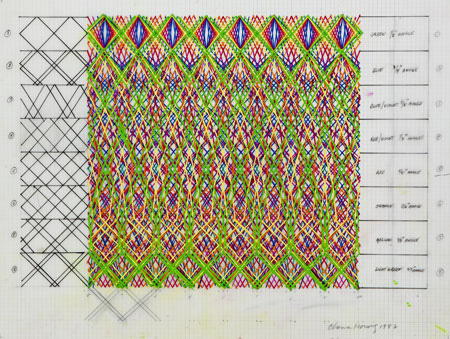 |
| Chanah Horwitz, "Canon # 10", 1983, Plaka on Mylar, 23-1/2 x 26-1/2 inch. © C Horwitz |
Finally, one aspect of the algorist definition remains open to
interpretation. An algorist, by definition, creates "art". The
definition does not identify what constitutes "art". One might employ
original algorithms and create work that one person may experience as art
while another may not experience it as art. For example a mathematician may
use original algorithms in creating a scientific visualization that some may
view as "art". Yet the visualization may not fit another's conception of
"art". While we may have our various preferences the definition cannot and,
in my view, should not attempt to define what kind of work belongs in
the world of the art we choose to cultivate.
BREADTH OF ALGORIST ART
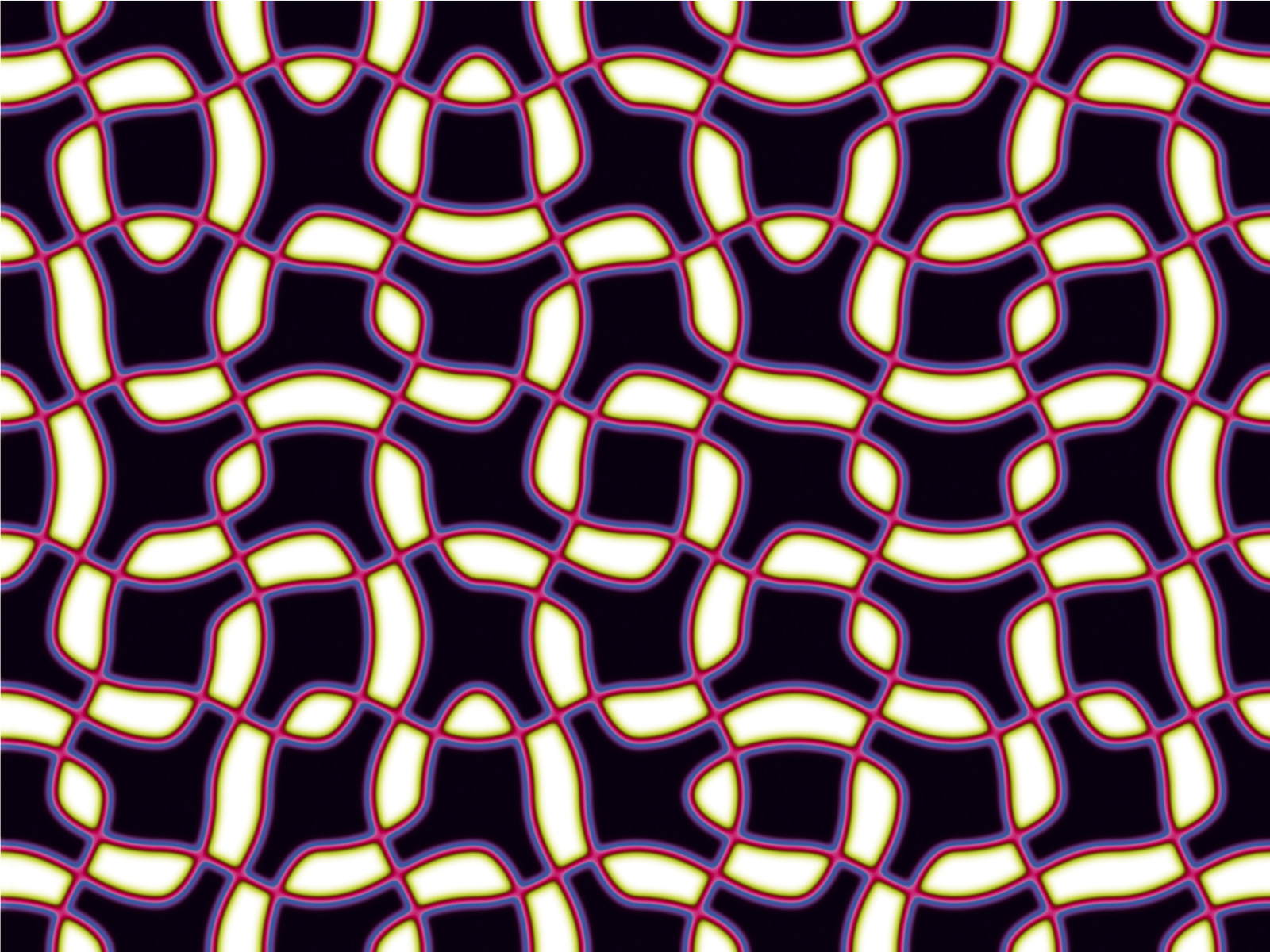 |
Paul Brown, 1997, UK, Australia Gymnasts, Print, 60 X 80 cm |
This essay can only suggest the breadth of this practice. For example let me point to the important work of Paul Brown, an algorist whose writings and newsletters kept us well informed for years, even before we had the web. Dividing his living between London and Australia he identifies with those circles in the UK involved with the theory and practice of generative art. This includes Ernest Edmonds whom I first met in 1996 at his annual conference on "Creativity and Cognition" at Loughborough. As an algorist, deeply involved with the nature and practice of generative art, his writing, teaching and art work has been felt widely by colleagues and students.
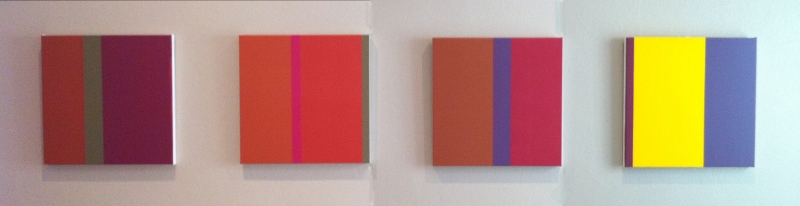 |
| Ernest Edmonds, Four Shaping Forms,
2009, Acrylic and digital print on canvas, 50x50 cm each. © E Edmonds |
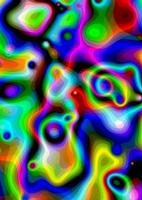 |
Yoshiyuki Abe,
Japan
Stochastica
Image 97
► © Yoshiyuki Abe, Japan |
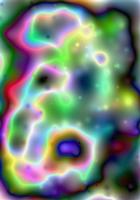 |
Algorists who had been active since the 1970's had no common identity and therefore no web site or historical reference to their work specifically. In 1996 J.P. Hebert introduced several pages dedicated to the algorists. These pages spelled out essential features of "algorist" art, historical precedents, and links to related topics and issues. These initial pages identified an informal group of active algorists including Yoshiyuke Abbe, Harold Cohen, Charles Csuri, Hans Dehlinger, Helaman Ferguson, Manfred Mohr, Vera Molnar, Mark Wilson, and others.
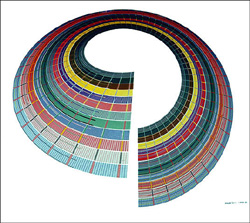 |
Mark Wilson USA,
"12D90",
1990 plotter drawing
36 x 48 inches (91 x 121 cm.), pen & ink on paper. Private collection. © m.wilson |
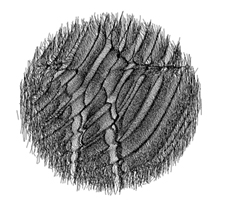 |
Vlatko
Čerić,
2005, Zagreb, Croatia Evolution #5 of 10, digital print, 6.7" by 6.7" Hahnemuhle paper measuring 11.7" by 16.5" . Vlatko Čerić is one of many algorists, who employ generative procedures and demonstrate the breadth and depth of algorist artistic achievement. ©Vlatco Ceric |
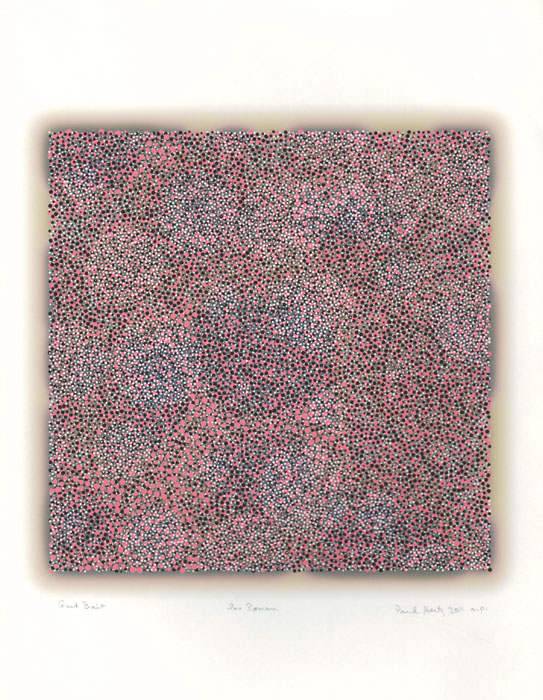 |
Paul Hertz, 2011. Chicago, USA. Good Bait, Algorithmic digital print, 8.5" by 11" |
Many first generation algorists worked with pen plotters as their first graphic interface. Some shared a common history that grew out of conceptual art and an interest in the emerging information processing technologies of the 1960's. Put in perspective the work of first generation algorists marked a turning point in the history of western culture. Algorithmic procedures have changed everything from the way we create film and music to the way we run wall street, the military and our communications systems.
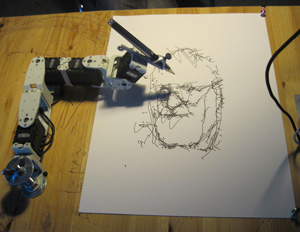 |
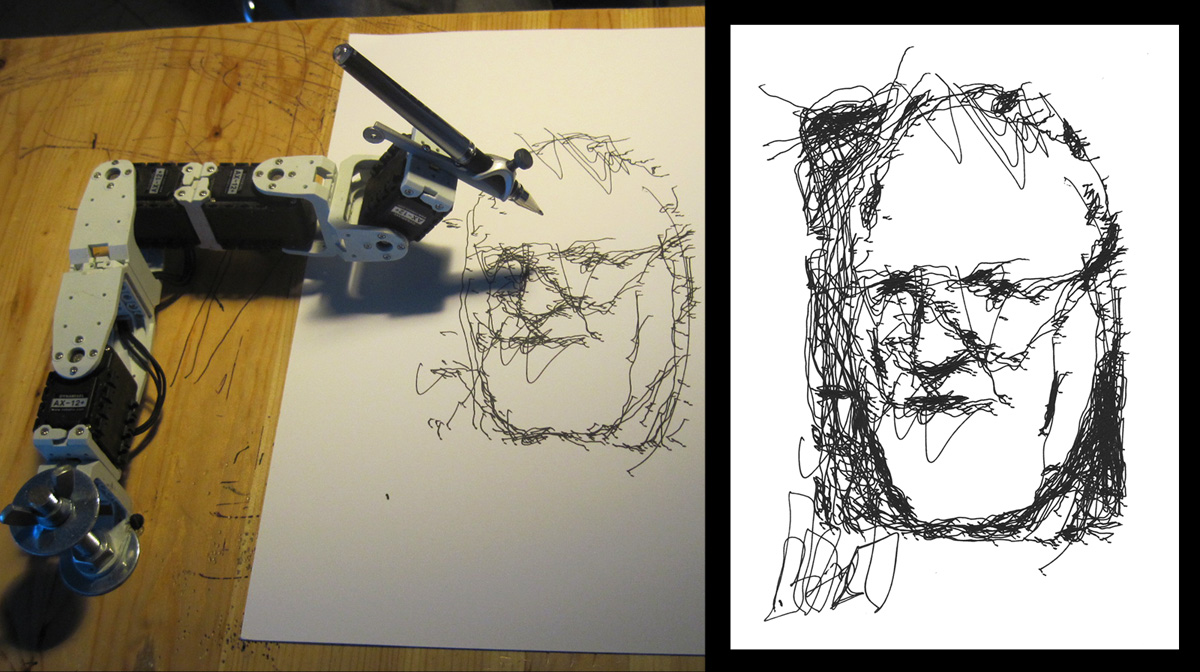
"Paul", a robotic arm drawing my portrait on Sept 28, 2011, at the University of London, Goldsmiths. This robotic arm, "Paul", is the work of Patrick Tresset in "The Aikon Project". His research uses computational and robotic technologies to explore drawing activity with a focus on face sketching. |
The numerous sites and groups involved with algorist art at the turn of the century testify to a remarkable growth of coded procedures in virtually all the arts. Other terms may be used but they all share one thing in common - algorithmic procedure. This holds for generative art, genetic art, bio arts and cyber arts as well as a wide range of interactive and robotic work. As this 21st Century unfolds algorithmic art emerges as a major force in the arts. (See Note 1.a for a list with links)
ALGORISTS AT THE KAVLI INSTITUTE FOR THEORETICAL PHYSICS
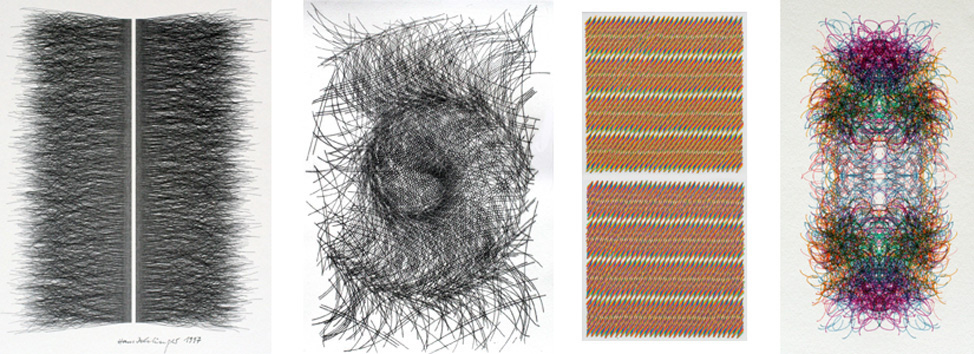 left to right: Hans Dehlinger, Jean Pierre Hebert, Channa Horwitz, Roman Verostko Above: work shown in " The Algorists: four visual artists in the land of Newton", curated by Hebert at the Kavli Institute for Theoretical Physics, University of California, Santa Barbara, USA. March 13-June 30, 2006. Click here for catalogue |
While algorists themselves presented their own shows and participated in group shows it was Jean Pierre Hebert who curated the first exhibition formally identified as "algorist". This exhibition was presented at the Kavli Institute for Theoretical Physics in 2006 (University of California at Santa Barbara). The catalogue for this show provides an excellent introduction to the nature of algorithmic practice with specific examples of algorithmic drawings by four artists: The Algorists: four visual artists in the land of Newton".
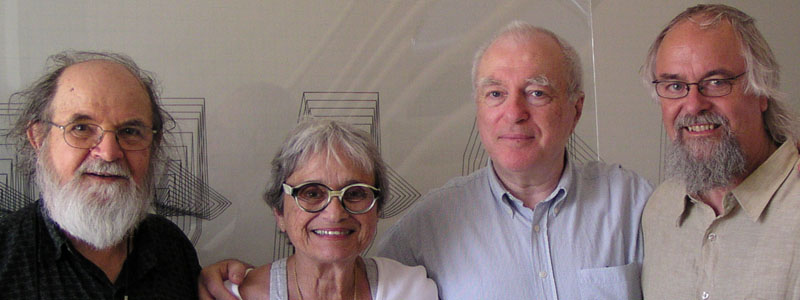 Artists in first algorist show: Roman Verostko, Channa Horwitz, Jean Pierre Hebert, Hans Dehlinger This picture was taken in 2005 in Channa Horwtiz' studio, Santa Monica CA., USA. |
In the years ahead we may expect, as the history is written, that the last quarter of the 20th Century will emerge as the heart of the algorithmic revolution that would profoundly impact world culture in the 21st Century.
"AMERICAN ALGORISTS LINEAR SUBLIME"
Thanks to the curatorial work of Grant Taylor and his years of research a well informed catalogue was published for a showing of four American algorists in the fall of 2013. His catalogue essay views the "American Algorists" as an important chapter in the history of American Art. The show, celebrating the 20th anniversary of the New York Digital Salon, opened first on August 30th at the Suzanne H. Arnold Art Gallery, Lebanon Valley College, Annville, PA. Later, on October 27, the New York showing opened at the Westside Gallery, School of Visual Arts in Manhattan.
DOWNLOAD: The American Algorists: Linear Sublime.
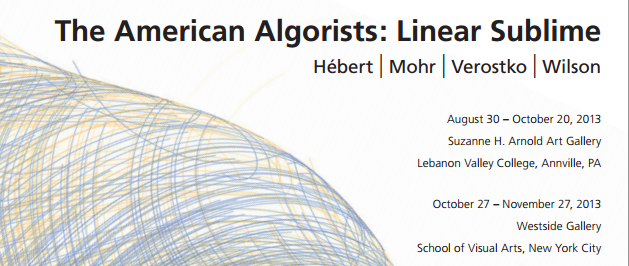
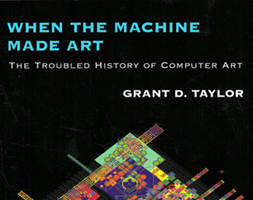
This catalogue was followed by the publication in 2014 of Taylor's extensive research on the unfolding milieu of "Computer Art". The sub-title of this book, "The Troubled History of Computer Art", identifies issues well known to those artists who pioneered the form-generating leverage of computers. When the Machine Made Art: The Troubled History of Computer Art (International Texts in Critical Media Aesthetics Vol 7, Bloomsbury, NY) 2014, by Grant D. Taylor,